

15-6 Forced Oscillations and Resonance#
Prompts
What is the difference between free oscillation and forced (driven) oscillation? At what frequency does a forced oscillator oscillate—\(\omega\) or \(\omega_d\)?
Define resonance. When you push a swing, at what frequency should you push to get the largest response? Why?
Sketch amplitude \(x_m\) versus \(\omega_d/\omega\). Where is the peak? How does increasing the damping constant \(b\) change the resonance curve?
Why did intermediate-height buildings collapse in the 1985 Mexico City earthquake while shorter and taller ones survived?
Aircraft wings have natural frequencies. Why must designers ensure these do not match the engine’s vibration frequency?
Lecture Notes#
Overview#
Free oscillation: system disturbed and left alone; oscillates at its natural frequency \(\omega\).
Forced oscillation: system driven by an external periodic force at driving frequency \(\omega_d\); the system oscillates at \(\omega_d\), not \(\omega\).
Resonance: when \(\omega_d = \omega\), the amplitude and velocity amplitude are (approximately) greatest. Pushing at the “right” frequency produces a large response.
Free |
Forced |
|---|---|
No external drive |
External force \(F_d \cos(\omega_d t)\) |
Oscillates at \(\omega\) |
Oscillates at \(\omega_d\) |
Amplitude set by initial conditions |
Amplitude depends on \(\omega_d\), \(\omega\), \(\tau\) |
Forced oscillations#
Recall \(\tau = m/b\) (relaxation time from 15-5).
A forced oscillator (e.g., a swing being pushed, a block–spring with a moving support) is driven by an external periodic force. Its displacement is
The system oscillates at the driving frequency \(\omega_d\), not the natural frequency \(\omega\).
Amplitude squared (Lorentzian-shaped):
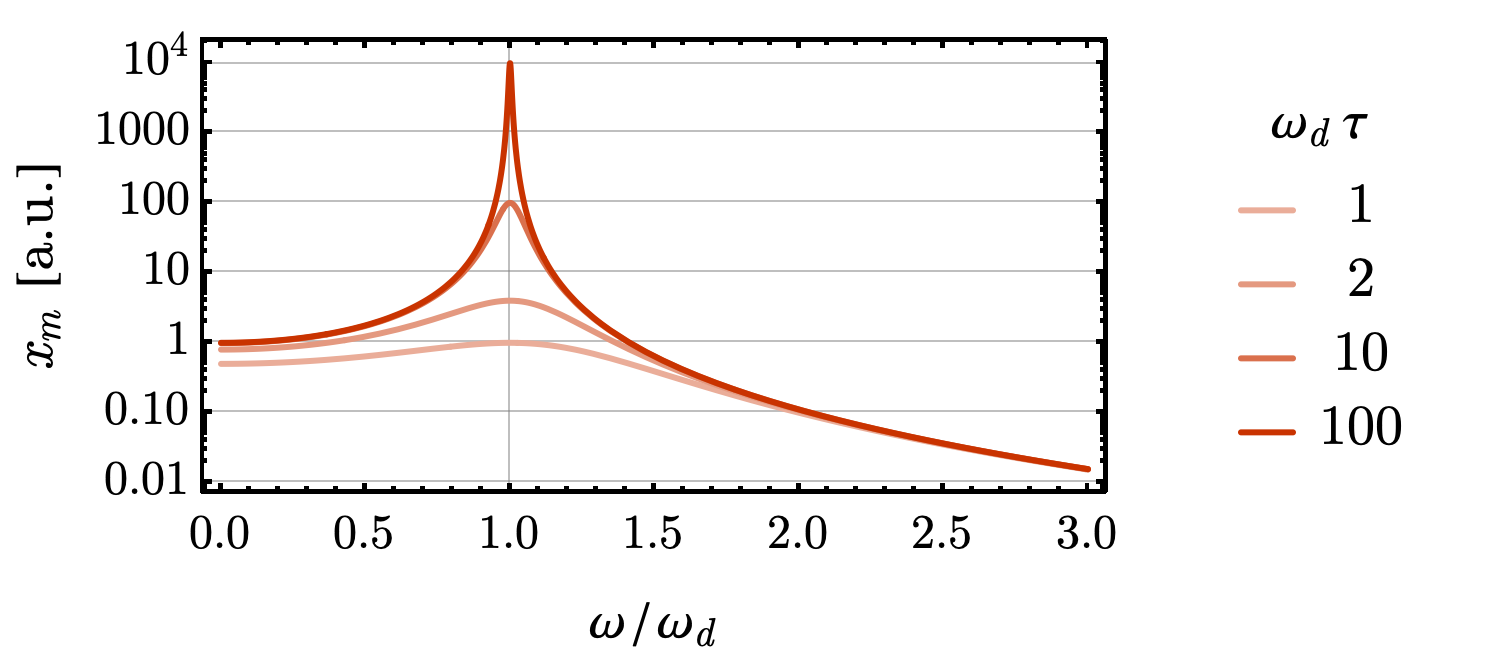
Fig. 17 Amplitude \(x_m\) versus \(\omega_d/\omega\) for different damping levels. The peak is near \(\omega_d \approx \omega\). Less damping → taller, narrower resonance peak.#
Resonance#
Resonance occurs when the driving frequency matches the natural frequency:
At resonance, the velocity amplitude \(v_m\) is greatest.
The displacement amplitude \(x_m\) is (approximately) greatest at the same condition.
Physical picture: The driving force does work on the oscillator most efficiently when it pushes in phase with the motion—i.e., when the drive frequency matches the natural frequency.
Pushing a swing
Children learn by trial and error: push at the natural frequency and the swing grows. Push at other frequencies (too fast or too slow) and the response is smaller—the force is often out of phase with the motion.
Resonance curve and damping#
A plot of amplitude \(x_m\) versus \(\omega_d/\omega\) shows a resonance peak near \(\omega_d = \omega\) (Fig. 17).
Damping |
Relaxation time \(\tau = m/b\) |
Resonance peak |
|---|---|---|
Less \(b\) |
Longer \(\tau\) |
Taller, narrower peak |
More \(b\) |
Shorter \(\tau\) |
Shorter, broader peak |
Light damping: sharp resonance; large amplitude at \(\omega_d = \omega\), small elsewhere.
Heavy damping: broad peak; amplitude varies less with frequency.
Examples: resonance in the real world#
Resonance can be dangerous
If a structure is driven at its natural frequency, oscillations can grow large enough to cause failure. Designers must avoid matching driving frequencies (engines, wind, earthquakes) to natural frequencies.
Aircraft: Wings have natural frequencies. If the engine’s vibration frequency matches a wing mode, the wing can oscillate violently (flutter). Designers ensure these frequencies do not coincide.
Mexico City, 1985: An earthquake far from the city sent seismic waves at ~3 rad/s. Mexico City sits on soft lake-bed soil, which amplified the waves. Many intermediate-height buildings had natural frequencies near 3 rad/s and resonated—they collapsed. Shorter buildings (higher \(\omega\)) and taller buildings (lower \(\omega\)) did not resonate and survived.
Freeway collapse, 1989 SF earthquake: A section built on mudfill had a natural frequency that matched the seismic waves; resonance contributed to the collapse.
Summary#
Forced oscillator: driven at \(\omega_d\); oscillates at \(\omega_d\); amplitude \(x_m\) depends on \(\omega_d\), \(\omega\), \(\tau\).
Resonance: \(\omega_d = \omega\); amplitude and velocity amplitude (approximately) maximum.
Resonance curve: peak near \(\omega_d/\omega = 1\); less damping → taller, narrower peak.
Danger: driving at natural frequency can cause large, destructive oscillations.