

14-7 Bernoulli’s Equation#
Prompts
State Bernoulli’s equation. What does each term represent (pressure, kinetic, gravitational)?
For horizontal flow (\(y\) constant), how are pressure and speed related? Where is pressure higher—in a narrow or wide section?
Why does a water stream from a faucet “neck down” as it falls?
A hole is punched in a water tank at depth \(h\) below the surface. What is the exit speed of the water? (Torricelli’s result)
Bernoulli’s equation is energy conservation. What are the three forms of energy per unit volume?
Lecture Notes#
Overview#
Bernoulli’s equation: Conservation of total energy density for ideal fluid flow.
Three energy densities (per unit volume): (1) Pressure \(p\)—work per volume, potential to expand; (2) Kinetic \(\frac{1}{2}\rho v^2\); (3) Gravitational \(\rho g y\).
Key result: Higher speed → lower pressure (for horizontal flow).
Bernoulli’s equation#
For steady, incompressible, nonviscous flow along a tube of flow:
Term |
Physical name |
Energy density |
Intuitive meaning |
|---|---|---|---|
\(p\) |
Static pressure |
Pressure energy density |
Work per volume; energy stored from compression; fluid’s potential to expand and do work |
\(\frac{1}{2}\rho v^2\) |
Dynamic pressure |
Kinetic energy (KE) density |
KE per unit volume from macroscopic ordered motion |
\(\rho g y\) |
Hydrostatic pressure |
Gravitational potential energy (PE) density |
PE per unit volume from height in gravity field (\(y\) upward) |
Physical meaning: The sum of pressure, kinetic, and gravitational energy per unit volume is conserved along a streamline. Bernoulli’s equation is energy conservation for an ideal fluid.
Note
Fluid at rest: Set \(v_1 = v_2 = 0\). Then \(p_2 = p_1 + \rho g(y_1 - y_2)\)—we recover hydrostatic pressure Eq. (16).
Horizontal flow: speed and pressure#
If \(y\) is constant (horizontal tube):
Higher speed → lower pressure. Where streamlines are close together (fast flow), pressure is low; where they spread (slow flow), pressure is high.
Force perspective: A fluid element entering a narrow section must accelerate (\(F = ma\)). That requires higher pressure behind than in front—so pressure is lower in the narrow, fast region.
Energy perspective: Pressure energy is converted into kinetic energy.
Poll: Air tube with water columns
Air flows through a horizontal channel with a wide section and a narrow section. Two vertical tubes connect the channel to a basin of water (each tube has one end in the basin and the other connected to the channel). Which tube has the higher water level?
(A) Tube at the wide section
(B) Tube at the narrow section
(C) Same height
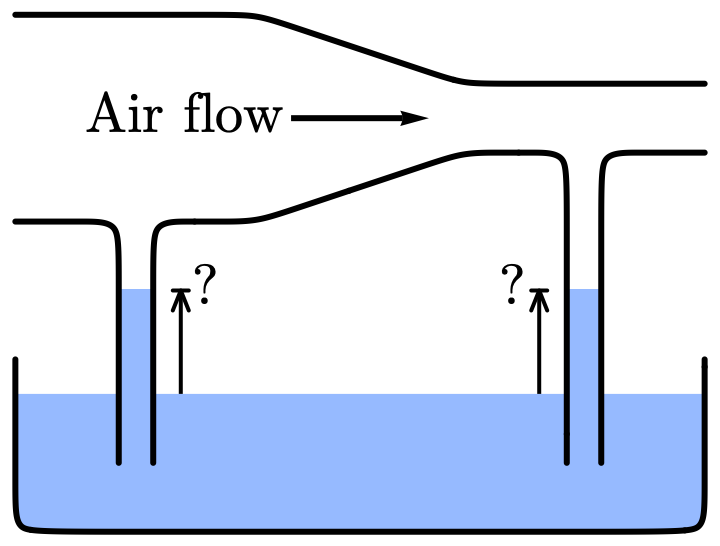
Fig. 11 Air channel (wide → narrow) with tubes to water basin; which tube has higher water level?#
Poll: Hurricane roof
High-speed wind blows over a flat roof. The roof can lift off. Compared to the still air inside, the fast air outside has:
(A) Higher pressure
(B) Lower pressure
(C) Same pressure
(D) Higher kinetic energy density but same pressure
Applications#
Faucet stream: Water falling from a tap speeds up (\(v\) increases). By continuity \(Av = \text{constant}\), so \(A\) must decrease—the stream “necks down.”
Leaky tank (Torricelli): A hole at depth \(h\) below the water surface. Take point 1 at the surface (\(p_1 = p_0\), \(v_1 \approx 0\), \(y_1 = h\)) and point 2 at the hole (\(p_2 = p_0\), \(y_2 = 0\)). Bernoulli gives
Same as the speed of free fall from height \(h\).
Example: Blowing over a penny
A penny (radius \(r \approx 1.0\;\text{cm}\), mass \(m \approx 2.5\;\text{g}\)) lies flat on a table. You blow air over the top. The fast-moving air has lower pressure than the still air below; the pressure difference \(\Delta p\) provides an upward force. For lift: \(\Delta p \cdot \pi r^2 \geq mg\). With \(\rho_{\text{air}} \approx 1.2\;\text{kg/m}^3\) and Bernoulli: \(\frac{1}{2}\rho v^2 \approx \Delta p\). So \(v \geq \sqrt{2mg/(\rho \pi r^2)} \approx 36\;\text{m/s}\)—you need to blow quite hard!
Example: Water emerging from pipe
Water exits a pipe at speed 4.0 m/s. The pipe is horizontal and open to the atmosphere. If the pipe narrows upstream, the pressure there is higher than \(p_0\). For a vertical pipe with exit at \(y = 0\) and a point at height \(h\) above it where \(v \approx 0\): Bernoulli gives \(p_0 + \rho g h = p_0 + \frac{1}{2}\rho v^2\), so \(h = v^2/(2g) \approx 0.82\;\text{m}\). The gauge pressure at the top equals the kinetic energy density at the exit.
Poll: Two buckets with same hole
Two buckets have the same hole size at the bottom and the same initial water volume and height. Bucket A is wide at the top and narrow at the bottom; Bucket B is narrow at the top and wide at the bottom. Which empties first?
(A) Bucket A empties first
(B) Bucket B empties first
(C) They empty simultaneously
(D) Cannot determine without more information
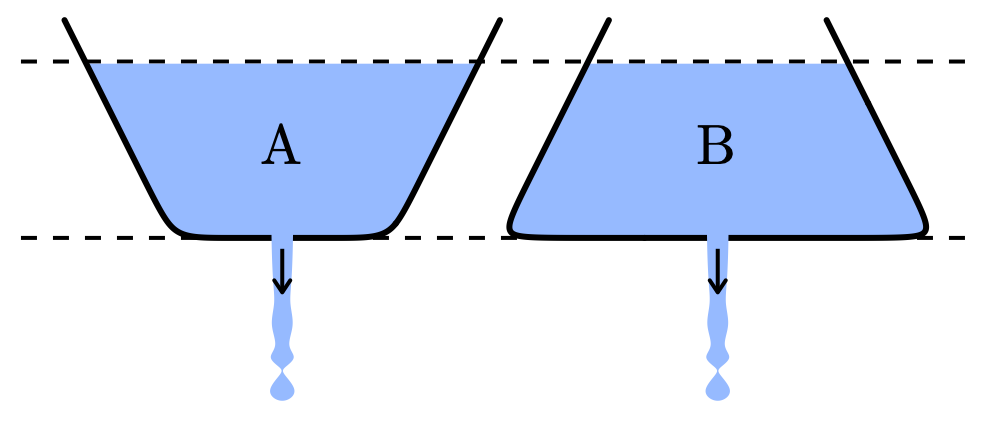
Fig. 12 Two buckets with same initial water level and hole size: (A) wide top, narrow bottom; (B) narrow top, wide bottom.#
Summary#
Bernoulli’s equation: \(p + \frac{1}{2}\rho v^2 + \rho g y = \text{constant}\) (energy conservation)
Horizontal flow: \(p + \frac{1}{2}\rho v^2 = \text{constant}\); faster → lower pressure
Torricelli: Exit speed from hole at depth \(h\) is \(v = \sqrt{2gh}\)