

15-3 An Angular Simple Harmonic Oscillator#
Prompts
What is a torsion pendulum? Where does the stiffness come from, and what provides the inertia?
Write the angular analog of Hooke’s law. How does the restoring torque \(\tau\) depend on angular displacement \(\theta\)?
For an angular SHM oscillator, how does the period \(T\) depend on rotational inertia \(I\) and torsion constant \(\kappa\)? Compare with the linear spring–block case.
A rod, a disk, and a ball (same mass, same size) are each hung from the same torsion wire, one at a time. Which has the longest period? Why?
The angular acceleration \(\alpha\) in angular SHM satisfies \(\alpha = -\omega^2 \theta\). How do you derive this from \(\tau = I\alpha\) and the restoring torque?
Lecture Notes#
Overview#
A torsion pendulum is the angular analog of a spring–block oscillator: a disk or object suspended by a wire that twists.
Stiffness comes from the wire’s resistance to twisting; inertia comes from the object’s rotational inertia \(I\).
The same SHM structure applies: restoring torque \(\tau \propto -\theta\), with period \(T = 2\pi\sqrt{I/\kappa}\).
Concept |
Linear |
Angular |
|---|---|---|
Coordinate |
\(x\) (position) |
\(\theta\) (angular displacement) |
Acceleration |
\(a=d^2x/dt^2\) (acceleration) |
\(\alpha = d^2\theta/dt^2\) (angular acceleration) |
Inertia |
\(m\) (mass) |
\(I\) (moment of inertia) |
Stiffness |
\(k\) (spring constant) |
\(\kappa\) (torsion constant) |
KE |
\(\frac{1}{2}m(dx/dt)^2\) |
\(\frac{1}{2}I(d\theta/dt)^2\) |
PE |
\(\frac{1}{2}kx^2\) |
\(\frac{1}{2}\kappa\theta^2\) |
Force / Torque |
\(F = m a = -kx\) |
\(\tau = I\alpha = -\kappa\theta\) |
Period |
\(T = 2\pi\sqrt{m/k}\) |
\(T = 2\pi\sqrt{I/\kappa}\) |
The torsion pendulum#
A torsion pendulum is an object (e.g., a disk) suspended from a wire. When the wire is twisted and released, the object oscillates in angular simple harmonic motion.
Restoring torque. Twisting the wire produces a torque that opposes displacement:
\(\kappa\) (kappa) is the torsion constant—a property of the wire (length, diameter, material). It plays the role of spring constant \(k\).
Energy (primary derivation):
Rotational kinetic energy: \(K = \frac{1}{2}I(d\theta/dt)^2\)
Potential energy in the twisted wire: \(U = \frac{1}{2}\kappa\theta^2\)
Total energy: \(E = K + U\) → inertia = \(I\), stiffness = \(\kappa\)
By section 15-2, Eq. (59):
Moment of inertia
The moment of inertia \(I\) is defined as the coefficient of the rotational kinetic energy \(K = \frac{1}{2}I(d\theta/dt)^2\) that makes it quadratic in \(d\theta/dt\).
For a rigid body, \(I = \int\rho\,r^2\,dV\) (or \(\sum m_i r_i^2\) for discrete masses)—each mass element contributes \(m_i r_i^2\) to the total.
\(I\) depends on how mass is distributed around the rotation axis: mass farther from the axis contributes more to \(I\).
Torque method (alternative):
Newton’s second law for rotation: \(\tau = I\alpha\), with \(\alpha = d^2\theta/dt^2\)
Restoring torque: \(\tau = -\kappa\theta\)
So \(I\alpha = -\kappa\theta\), giving
Comparing with the SHM hallmark \(\alpha = -\omega^2\theta\) yields the same \(\omega\) and \(T\).
Physical interpretation:
Larger \(I\) → longer period (slower oscillations)
Stiffer wire (larger \(\kappa\)) → shorter period (faster oscillations)
Comparing two torsion pendulums#
The torsion constant \(\kappa\) depends only on the wire. If you hang different objects from the same wire, one at a time, \(\kappa\) stays the same; only \(I\) changes. So \(T \propto \sqrt{I}\)—measuring periods lets you compare rotational inertias.
Same wire (same \(\kappa\)), different objects \(a\) and \(b\):
If \(T_b > T_a\), then \(I_b > I_a\)—the object with the longer period has the larger rotational inertia.
Poll: Period and inertia
Three objects—a thin rod, a flat disk, and a ball—are each hung in turn from the same torsion wire (one at a time). All have the same mass and the same characteristic size (e.g., rod length = 2\(R\), disk and ball radius = \(R\)). When oscillating, which has the longest period?
(A) Rod
(B) Disk
(C) Ball
(D) All the same
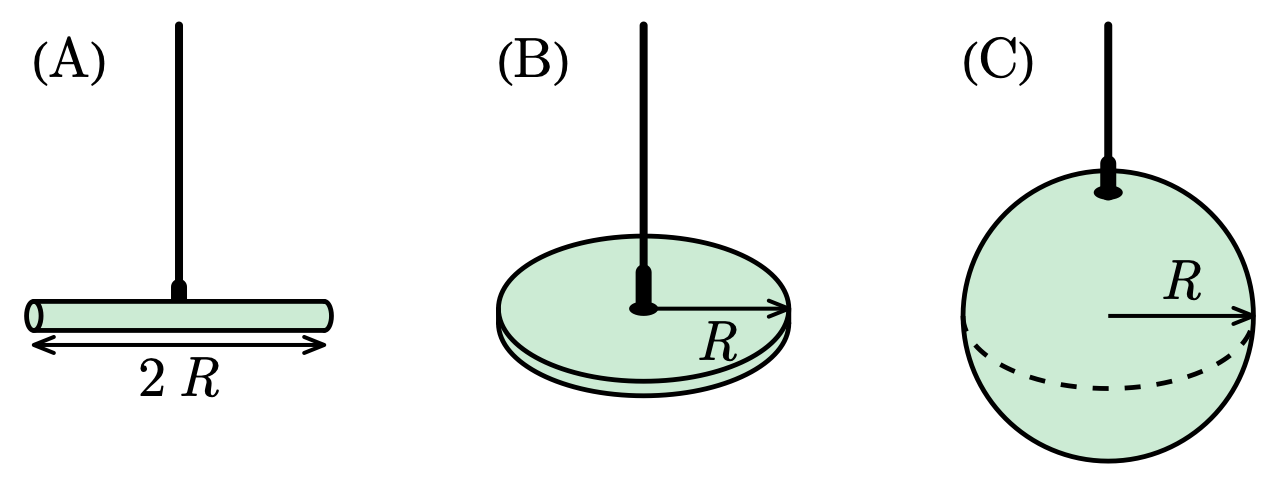
Fig. 15 (A) Thin rod, (B) disk, (C) ball—each suspended from the center of a torsion wire.#
Summary#
Torsion pendulum: object on a twisted wire; restoring torque \(\tau = -\kappa\theta\).
Energy method (section 15-2): \(E = \frac{1}{2}I(d\theta/dt)^2 + \frac{1}{2}\kappa\theta^2\) → inertia \(I\), stiffness \(\kappa\) → \(\omega = \sqrt{\kappa/I}\), \(T = 2\pi\sqrt{I/\kappa}\). Torque method (\(\tau = I\alpha\)) gives the same result.
Moment of inertia \(I\): defined from \(K = \frac{1}{2}I(d\theta/dt)^2\); depends on mass distribution around the axis.
Same wire, different objects: \(\kappa\) unchanged; \(I_b/I_a = (T_b/T_a)^2\)—measure periods to compare rotational inertias.
Discussions#
Moment of inertia: definition and computation#
Definition from energy: The rotational kinetic energy \(K = \frac{1}{2}I(d\theta/dt)^2\) defines the moment of inertia \(I\): it is the coefficient that makes \(K\) quadratic in angular speed. \(I\) measures resistance to angular acceleration; mass farther from the axis contributes more (the \(r^2\) factor).
Two forms:
Discrete: \(I = \sum_i m_i r_i^2\)
Continuous: \(I = \int \rho\,r^2\,dV\)
Here \(r\) is the perpendicular distance from the mass element to the rotation axis.
How to compute:
Choose the rotation axis.
For each mass element, find \(r\) (shortest distance to the axis).
Sum \(m_i r_i^2\) (discrete) or integrate \(\rho\,r^2\,dV\) (continuous).
Parallel-axis theorem: If the axis is parallel to one through the center of mass, distance \(d\) apart, then \(I = I_{\text{CM}} + Md^2\). Use this to find \(I\) about an end (e.g., rod about end) from \(I\) about the center.
Examples table#
Object |
Axis |
\(I\) |
|---|---|---|
Dumbbell (2 masses \(m\) at \(\pm d/2\)) |
Perpendicular, through center |
\(\frac{1}{2}md^2\) |
Thin rod (length \(L\)) |
Perpendicular, through center |
\(\frac{1}{12}mL^2\) |
Thin rod (length \(L\)) |
Perpendicular, through end |
\(\frac{1}{3}mL^2\) |
Disk (radius \(R\)) |
Perpendicular, through center |
\(\frac{1}{2}MR^2\) |
Thin spherical shell (radius \(R\)) |
Through center |
\(\frac{2}{3}MR^2\) |
Solid ball (radius \(R\)) |
Through center |
\(\frac{2}{5}MR^2\) |
Worked examples#
Example 1: Dumbbell
Setup: Two point masses \(m\) each at distance \(d/2\) on either side of the rotation axis (perpendicular to the line joining them).
Computation: \(I = m(d/2)^2 + m(d/2)^2 = 2m(d/2)^2 = \frac{1}{2}md^2\).
Each mass contributes \(m_i r_i^2\); both have \(r = d/2\).
Example 2: Thin rod about center
Setup: Thin rod of length \(L\) and mass \(m\); axis perpendicular to the rod, through its center.
Computation: Linear density \(\lambda = m/L\). Place the rod along the \(x\)-axis with center at \(x=0\). Each element \(dm = \lambda\,dx\) is at distance \(r = |x|\) from the axis:
Rod about end: Use parallel-axis theorem with \(d = L/2\): \(I = \frac{1}{12}mL^2 + m(L/2)^2 = \frac{1}{3}mL^2\).
Example 3: Solid ball
Result: \(I = \frac{2}{5}MR^2\) for a solid ball of mass \(M\) and radius \(R\), rotating about an axis through its center.
Computation: \(I = \int r_\perp^2\,dm\). Use spherical coordinates with the axis along \(z\): \(r_\perp = r\sin\theta\), \(dV = r^2\sin\theta\,dr\,d\theta\,d\phi\), so \(dm = \rho\,dV\).
\(\int_0^R r^4\,dr = R^5/5\). \(\int_0^{2\pi} d\phi = 2\pi\). For \(\int_0^\pi \sin^3\theta\,d\theta\), use \(\sin^3\theta = \sin\theta(1-\cos^2\theta)\) and \(u = \cos\theta\):
Thus \(I = \rho\cdot(R^5/5)\cdot(4/3)\cdot(2\pi) = (8\pi\rho/15)R^5\). With \(\rho = M/(4\pi R^3/3) = 3M/(4\pi R^3)\): \(I = \frac{2}{5}MR^2\).