

3.3.2 WKB Approximation#
Prompts
What is the WKB ansatz \(\psi = A(x)\,\mathrm{e}^{\mathrm{i}W(x)/\hbar}\,\mathrm{e}^{-\mathrm{i}Et/\hbar}\), and how does it reduce the time-independent Schrödinger equation to the Hamilton-Jacobi equation?
Why does the WKB amplitude take the form \(A \propto 1/\sqrt{p(x)}\) in the classically allowed region, and how does this reflect probability conservation?
How does WKB describe tunneling through a classically forbidden barrier, and where does the factor \(T \approx \mathrm{e}^{-2\gamma}\) come from?
What are turning points, and why does the connection formula across a soft turning point require a \(\pi/4\) phase shift?
When does the WKB approximation break down, and what is the dimensionful validity criterion?
Lecture Notes#
Overview#
Section 3.3.1 showed that stationary phase turns the path integral into a semiclassical propagator: a rapidly varying classical-action phase multiplied by a slowly varying fluctuation prefactor. For an energy eigenstate the classical action separates into a spatial part and a time part, \(S_\mathrm{cl}=W(x)-Et\), so the same structure becomes a wavefunction with phase \(W(x)/\hbar\) and amplitude \(A(x)\). This is the WKB approximation. Its physical picture is direct: the phase records the local classical action, while the amplitude records how nearby paths spread or concentrate. In this note we turn that picture into a practical approximation by substituting the WKB form into the Schrödinger equation: the leading term gives Hamilton-Jacobi mechanics, the next term fixes the amplitude, and continuing to imaginary momentum describes tunneling.
The WKB Ansatz#
Motivated by the semiclassical propagator, look for stationary states of energy \(E\) in the form
Substituting into the time-independent Schrödinger equation \(-(\hbar^{2}/2m)\psi'' + V\psi = E\psi\) and collecting terms order by order in \(\hbar\) produces a hierarchy of equations:
WKB equations
Leading order (\(\hbar^{0}\)): \(W(x)\) obeys the (time-independent) Hamilton-Jacobi equation
(101)#\[ \frac{1}{2m}\!\left(\frac{\mathrm{d}W}{\mathrm{d}x}\right)^{2} + V(x) = E. \]Next order (\(\hbar^{1}\)): \(A(x)\) obeys a continuity equation
(102)#\[ \frac{\mathrm{d}}{\mathrm{d}x}\!\left(A^{2}\,W'\right) = 0. \]
Derivation: WKB equations from Schrödinger
Substitute the WKB ansatz (100) into the time-independent Schrödinger equation \(-(\hbar^{2}/2m)\psi'' + V\psi = E\psi\). Compute the second derivative,
Multiply by \(-\hbar^{2}/(2m)\), add \((V-E)\psi\), cancel the common phase \(\mathrm{e}^{\mathrm{i}W/\hbar}\,\mathrm{e}^{-\mathrm{i}Et/\hbar}\), and multiply through by \(2m\) to expose the ordering in \(\hbar\):
For the equation to hold at every order in \(\hbar\) (treating \(\hbar\) as a small parameter), each bracketed group must vanish separately.
Order \(\hbar^{0}\). Setting the first bracket to zero gives the Hamilton-Jacobi equation (101). Solving for the phase gradient defines the local momentum (104),
Order \(\hbar^{1}\). Setting the second bracket to zero gives the amplitude equation (102),
Substituting \(W' = p\) (so \(W'' = p'\)),
Multiplying by \(A\) turns the left-hand side into a total derivative,
so \(A^{2}p\) is constant in \(x\) and the WKB amplitude takes the form \(A(x) = C/\sqrt{p(x)}\) — Eq. (106). Constancy of \(A^{2}p\) is exactly probability-current conservation \(j = (\hbar/m)\,A^{2}p/\hbar = A^{2}p/m\).
Order \(\hbar^{2}\). The remaining \(-\hbar^{2}A''/(2m)\) piece is dropped — it would couple \(A\) back into the Hamilton-Jacobi equation as a quantum correction (the Bohm potential) and lies beyond the leading-order WKB approximation.
The Hamilton-Jacobi equation says: the phase gradient is the local momentum of a classical particle of energy \(E\),
The two signs in (104) give the two WKB branches, corresponding to waves whose phase accumulates with positive or negative local momentum.
Substituting \(W'=p\) into the amplitude equation (102) gives \(\frac{\mathrm{d}}{\mathrm{d}x}(A^{2}p)=0\). The phase and amplitude are therefore fixed together:
WKB solutions
The phase \(W(x)\) accumulates the classical action along the orbit:
(105)#\[ W(x) = W(x_{*}) + \int_{x_{*}}^{x} p(x')\,\mathrm{d}x'. \]The amplitude \(A(x)\) follows from probability-current conservation \(A^{2}p=\text{const}\):
(106)#\[ A(x) = \frac{C}{\sqrt{p(x)}}. \]So \(\vert\psi\vert^{2}\propto 1/p\) is largest where the particle moves slowly — classically, the particle spends more time at small \(p\).
Allowed and Forbidden Regions#
Equation (104) gives a real \(p(x)\) where \(E > V(x)\) — the classically allowed region — and an imaginary \(p\) where \(E < V(x)\) — the classically forbidden region.
WKB wavefunctions
In the allowed region (\(E > V\)), with \(p(x) = \sqrt{2m(E-V)}\):
In the forbidden region (\(E < V\)), with \(\kappa(x) = \sqrt{2m(V-E)}\):
The two signs in each formula give independent solutions — right- vs left-moving in the allowed region; exponentially decaying vs growing in the forbidden region.
Validity of WKB approximation
WKB assumes a local classical momentum: over one de Broglie wavelength, the potential should look almost constant. Equivalently, the local wavelength
should change by much less than one wavelength over a wavelength:
Using \(p(x)=\sqrt{2m(E-V)}\), this becomes the dimensionful condition
This criterion makes the failure modes easy to diagnose:
Near a turning point, \(E=V(x)\), the right-hand side vanishes and the WKB amplitude \(1/\sqrt{p}\) diverges. The local plane-wave picture cannot be trusted there.
At a discontinuity, \(V'(x)\) is undefined, so there is no slowly varying potential to expand around.
Where the potential changes on the scale of a wavelength, neighboring points no longer have nearly the same local momentum, so the slowly varying amplitude assumption breaks down.
The cure near a smooth turning point is not to abandon semiclassics, but to replace the local WKB form by an Airy-function matching region.
Tunneling Through a Smooth Barrier#
Consider a particle of energy \(E\) incident on a smooth barrier with \(V > E\) between turning points \(a < b\) (Fig. Fig. 16).
WKB tunneling probability
Stitching the WKB solutions across both turning points gives the celebrated tunneling formula:
Transmission is exponentially sensitive to the integrated \(\sqrt{V-E}\) across the barrier.
Derivation: tunneling exponent from connection formulas
Pick the WKB solution with only an outgoing (right-moving) wave on the right of the barrier, \(x > b\), with amplitude \(F\):
Apply the connection formula (113) at \(x = b\) (allowed \(\to\) forbidden, going leftward into the barrier): the outgoing oscillation matches a purely decaying exponential just inside the barrier,
with \(|F'| = |F|\) up to factors of order unity from the connection. Continuing this decaying solution to \(x = a\), its magnitude has shrunk by the factor \(\mathrm{e}^{-\gamma}\) where \(\gamma = \frac{1}{\hbar}\int_{a}^{b}\kappa\,\mathrm{d}x\).
A second connection at \(x = a\) (forbidden \(\to\) allowed, leftward) maps this exponentially small value into an oscillatory wave on the left whose amplitude is therefore \(\mathrm{e}^{-\gamma}\) times the original outgoing amplitude. The transmission probability is the squared amplitude ratio,
The factor of two comes from squaring; the connection-formula prefactors give corrections of order unity that are ignored at WKB accuracy.
The penetration depth at energy \(E\) is \(\lambda_\text{decay}(x) = \hbar/\kappa(x)\) — the length scale on which the wavefunction decays inside the barrier.
Example: electron tunneling
Problem. Estimate \(T\) for an electron through a \(1\,\text{nm}\) barrier with \(V - E = 1\,\text{eV}\).
Solution. With \(a = 1\,\text{nm}\), \(V - E = 1.6\times 10^{-19}\,\text{J}\), \(m = 9.1\times 10^{-31}\,\text{kg}\), and a constant \(\kappa = \sqrt{2m(V-E)}\),
so \(T \sim \mathrm{e}^{-10} \approx 5\times 10^{-5}\). Rare but observable — this is why scanning tunneling microscopy and alpha decay work.
Poll: WKB in a forbidden region
In the classically forbidden region where \(V > E\), the local momentum \(p = \sqrt{2m(E-V)}\) becomes imaginary. What does WKB predict for \(\psi(x)\) there?
(A) It oscillates with increasing frequency the deeper one penetrates.
(B) It decays (or grows) exponentially with rate \(\kappa(x)/\hbar = \sqrt{2m(V-E)}/\hbar\), consistent with quantum tunneling.
(C) It becomes complex and unphysical, signaling the breakdown of WKB.
(D) It is constant, since classically the particle never enters the forbidden region.
Connection at a Turning Point#
At a soft turning point, the wavefunction changes character: oscillatory in the allowed region, exponentially decaying in the forbidden region. We need a rule to connect these two pieces continuously across the boundary, and that rule is what brings the famous \(\pi/4\) phase shift into WKB.
Where does \(\pi/4\) come from? Matching wave to exponential
The two regions host different functions — sinusoid on one side, exponential on the other. Continuity of \(\psi\) and \(\psi'\) across the boundary alone fixes the phase of the allowed-side wave. Consider Fig. Fig. 17 configuration:
Forbidden side. A decaying exponential \(\psi\propto\mathrm{e}^{+\kappa x}\) has the defining property \(\psi'/\psi=+\kappa\): the slope equals the value (up to \(\kappa\) factor rescaling).
Allowed side. A sinusoid \(\psi\propto\sin(kx+\phi)\) has \(\psi'/\psi=k\cot(kx+\phi)\). Continuity of \(\psi\) and \(\psi'\) at \(x=0\) forces \(k\cot\phi=\kappa\). Near the turning point \(k\approx\kappa\), so \(\cot\phi=1\), giving \(\phi=\pi/4\).
The matching forces the allowed-side wave to be at the \(\pi/4\) phase of its cycle at the boundary — precisely where \(\sin=\cos\) (slope equals value).
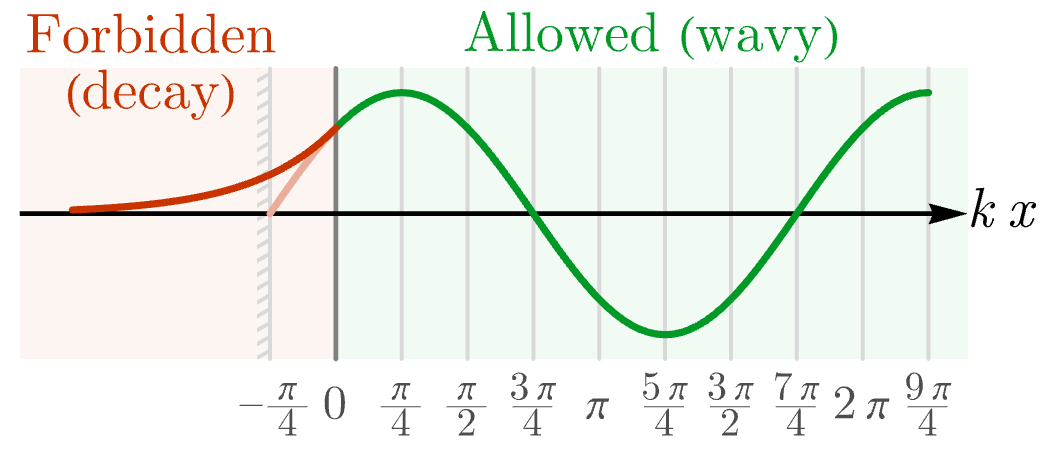
Fig. 17 The allowed-side wave \(\sin(kx+\pi/4)\) extrapolates to a node at \(kx=-\pi/4\) — the ghost wall (hatched line). The wave overshoots the classical turning point at \(x=0\) by \(\pi/4\) (in phase units) before being “reflected.”#
Ghost wall: \(\pi/2\) effective extra phase per soft turn
Equivalently: a soft turning point behaves like a hard wall retracted by \(\pi/4\) into the forbidden region. The wave overshoots the classical boundary by \(\pi/4\) (in phase units) before “hitting” the ghost wall.
A soft reflection has two halves: \(\pi/4\) in to the ghost wall, U-turn, \(\pi/4\) out. The wave acquires an effective extra phase of
per soft turning point. This per-turn result is the input that fixes the Bohr-Sommerfeld quantization rule of §3.3.3.
Connection formula at a soft turning point
For a turning point at \(x_0\) with the allowed region on the right and the forbidden region on the left (orientation of Fig. Fig. 17),
The matching argument above is the heuristic content; a more rigorous derivation linearizes \(V(x)\) near \(x_0\), reducing the Schrödinger equation to the Airy equation, and matches the Airy function’s asymptotic forms in the two regions (HW 3.3.2.6).
Summary#
WKB ansatz: \(\psi = A(x)\,\mathrm{e}^{\mathrm{i}W(x)/\hbar}\,\mathrm{e}^{-\mathrm{i}Et/\hbar}\).
Phase obeys Hamilton-Jacobi; phase gradient is the local momentum \(p(x) = \pm\sqrt{2m(E-V)}\).
Amplitude: \(A(x) = C/\sqrt{p}\) from probability conservation — large where the particle moves slowly.
Allowed vs forbidden: real \(p\) → oscillation; imaginary \(p\) → exponential decay.
Soft matching: at a turning point, continuity of \(\psi\) and \(\psi'\) forces the allowed-side wave to be at the \(\pi/4\) point of its cycle at the boundary.
Ghost wall: soft turn \(=\) hard wall retracted by \(\pi/4\) into the forbidden region; effective extra phase \(\pi/2\) per soft reflection.
Tunneling: \(T \approx \mathrm{e}^{-2\gamma}\) with \(\gamma = \int\kappa\,\mathrm{d}x/\hbar\).
Validity: \(\hbar|V'| \ll 2\sqrt{2m}(E-V)^{3/2}\); fails at turning points and discontinuities.
See Also
3.3.1 Stationary Phase Approximation: Asymptotics of rapidly oscillating integrals and classical limits.
3.3.3 Bohr-Sommerfeld Quantization: Quantization rules from WKB matching and periodic-orbit conditions.
3.2.3 Free Particle Propagator: Exact quadratic path integral—concrete oscillatory integral before turning-point analysis.
Homework#
1. Hamilton-Jacobi from WKB. Substitute the WKB ansatz \(\psi(x) = A(x)\,\mathrm{e}^{\mathrm{i}W(x)/\hbar}\) into the time-independent Schrödinger equation \(-\frac{\hbar^{2}}{2m}\psi'' + V(x)\psi = E\psi\).
(a) Collect terms by powers of \(\hbar\) and show that at leading order (\(\hbar^{0}\)) the phase \(W(x)\) satisfies the Hamilton-Jacobi equation \(\frac{1}{2m}(W')^{2} + V(x) = E\).
(b) At next order (\(\hbar^{1}\)), show that \(2A'W' + AW'' = 0\). Integrate this to obtain \(A \propto 1/\sqrt{W'} = 1/\sqrt{p(x)}\).
2. Allowed and forbidden regions. A particle of energy \(E\) moves in a slowly varying potential \(V(x)\).
(a) In the classically allowed region (\(E > V\)), write the WKB wavefunction \(\psi \sim p^{-1/2}\,\exp(\pm\frac{\mathrm{i}}{\hbar}\int^{x}p\,\mathrm{d}x')\) and explain physically why the amplitude \(1/\sqrt{p}\) means the particle is more likely found where it moves slowly.
(b) In the classically forbidden region (\(E < V\)), set \(p \to \mathrm{i}\kappa\) with \(\kappa = \sqrt{2m(V-E)}\) and show that the wavefunction decays as \(\psi \sim \kappa^{-1/2}\,\exp(-\frac{1}{\hbar}\int^{x}\kappa\,\mathrm{d}x')\).
3. Validity criterion. The WKB approximation requires \(\vert\mathrm{d}\lambda/\mathrm{d}x\vert \ll 2\pi\), where \(\lambda(x) = 2\pi\hbar/p(x)\) is the local de Broglie wavelength.
(a) Show that this is equivalent to the dimensionful condition \(\hbar\,\vert V'(x)\vert \ll 2\sqrt{2m}\,(E - V(x))^{3/2}\) in the allowed region.
(b) For a linear potential \(V(x) = Fx\) (constant force), identify where the criterion fails. Relate this to the turning point \(x_{0} = E/F\).
(c) For a Gaussian barrier \(V(x) = V_{0}\,\mathrm{e}^{-x^{2}/a^{2}}\) with energy \(E = V_{0}/4\), identify the classical turning points and discuss whether WKB is reliable away from them.
4. Square-barrier tunneling (heuristic). A particle of mass \(m\) and energy \(E < V_{0}\) encounters a rectangular barrier \(V(x) = V_{0}\) for \(0 < x < a\) and \(V = 0\) elsewhere. The discontinuous walls violate the WKB validity criterion \(\hbar|V'(x)| \ll 2\sqrt{2m}\,(E-V(x))^{3/2}\), so the formula below captures only the dominant exponential factor — the true transmission coefficient has an additional reflection-coefficient prefactor of order unity.
(a) Apply \(T \approx \mathrm{e}^{-2\gamma}\) with \(\gamma = \frac{1}{\hbar}\int_{0}^{a}\kappa\,\mathrm{d}x\) to obtain \(T \approx \exp\!\left(-\frac{2a}{\hbar}\sqrt{2m(V_{0} - E)}\right)\).
(b) Evaluate \(T\) for an electron (\(m \approx 9.1\times 10^{-31}\,\text{kg}\)) with \(V_{0} - E = 2\,\text{eV}\) and \(a = 0.2\,\text{nm}\). Is tunneling significant?
(c) Show that doubling the barrier width \(a\to 2a\) replaces \(T\) by \(T^{2}\) (much smaller). Explain why tunneling is exponentially sensitive to barrier width.
5. Penetration depth. The characteristic decay length of the wavefunction in a forbidden region is \(\lambda_\text{decay} = \hbar/\kappa\) with \(\kappa = \sqrt{2m(V - E)}\).
(a) Compute \(\lambda_\text{decay}\) for an electron at a metal surface with work function \(V - E = 5\,\text{eV}\). Express the answer in angstroms.
(b) Explain why this length scale makes scanning tunneling microscopy (STM) work: the tunneling current depends exponentially on the tip-surface distance.
6. Airy connection formula. At a soft turning point \(x_{0}\) with \(V'(x_{0}) > 0\), linearize the potential as \(V(x) \approx E + V'(x_{0})(x - x_{0})\).
(a) Show that the Schrödinger equation reduces to the Airy equation \(\psi'' = z\psi\) with \(z = (x - x_{0})/\ell\), and identify the length scale \(\ell = \bigl(\hbar^{2}/(2m\,V'(x_{0}))\bigr)^{1/3}\).
(b) The Airy function \(\mathrm{Ai}(z)\) decays exponentially for \(z\to+\infty\) (forbidden side) and oscillates for \(z\to-\infty\) (allowed side). Use its asymptotic forms to recover the connection formula \(\frac{1}{\sqrt{\kappa}}\mathrm{e}^{-\int_x^{x_0}\kappa\,\mathrm{d}x'/\hbar} \longleftrightarrow \frac{2}{\sqrt{p}}\sin\!\bigl[\int_{x_0}^{x}p\,\mathrm{d}x'/\hbar + \pi/4\bigr]\) with the \(\pi/4\) phase shift.
(c) Explain in one sentence why omitting the \(\pi/4\) shift in the bound-state quantization rule of §3.3.3 would mis-predict the harmonic-oscillator zero-point energy.
★ 7. Double-well tunnel splitting. Consider a symmetric double-well potential with two minima separated by a barrier of width \(\sim a\). Let \(\omega\) be the small-oscillation frequency in either well and \(\gamma = \frac{1}{\hbar}\int_\text{barrier}\kappa\,\mathrm{d}x\).
(a) Estimate the tunneling amplitude \(\Delta \sim \tfrac{1}{2}\hbar\omega\,\mathrm{e}^{-\gamma}\) from the WKB tunneling formula (the same energy scale as the uncoupled ground state in part (b)).
(b) Explain why \(\Delta\) lifts the degeneracy of the two single-well ground states, splitting them by \(\Delta E \approx 2\Delta\).
(c) For the ammonia molecule \(\mathrm{NH}_{3}\), the nitrogen tunnels with \(\gamma \approx 5\). Estimate \(\Delta E/(\hbar\omega)\). Is the splitting large or small compared to a single-well excitation?