

2.2.3 Addition of Angular Momenta#
Prompts
Explain the difference between uncoupled and coupled bases. When is each one useful?
State the triangle rule for adding \(j_1\) and \(j_2\). Verify the dimension count for two spin-1/2 particles.
What are Clebsch-Gordan coefficients? Derive the singlet and triplet states for two spin-1/2 particles.
How does spin-orbit coupling \(\hat{L} \cdot \hat{S}\) lead to fine structure? Why is the coupled basis essential?
Lecture Notes#
Overview#
When two systems each carry angular momentum — whether orbital and spin, or spin and spin — the total angular momentum \(\hat{\boldsymbol{J}} = \hat{\boldsymbol{J}}_1 + \hat{\boldsymbol{J}}_2\) obeys addition rules with no classical analog. The combined Hilbert space admits two natural bases: the uncoupled basis \(\vert j_1, m_1; j_2, m_2\rangle\) (individual projections known) and the coupled basis \(\vert J, M\rangle\) (total angular momentum known). The Clebsch-Gordan coefficients provide the unitary change of basis, and the triangle rule determines which total angular momenta are allowed.
Two Bases for the Same Space#
The combined system lives in \(\mathcal{H}_{j_1} \otimes \mathcal{H}_{j_2}\), with dimension \((2j_1+1)(2j_2+1)\).
Uncoupled basis \(\vert j_1, m_1\rangle\vert j_2, m_2\rangle\): eigenstates of \(\hat{J}_{1z}\) and \(\hat{J}_{2z}\) separately. Good quantum numbers: \(m_1, m_2\).
Coupled basis \(\vert J, M\rangle\): eigenstates of \(\hat{J}^2_{\text{tot}}\) and \(\hat{J}_{z,\text{tot}}\). Good quantum numbers: \(J, M\).
Both span the same space and are related by a unitary transformation.
Triangle Rule
When adding angular momenta \(j_1\) and \(j_2\), the allowed total angular momentum is:
Dimension check: \(\displaystyle\sum_{J=\vert j_1-j_2\vert}^{j_1+j_2}(2J+1) = (2j_1+1)(2j_2+1)\).
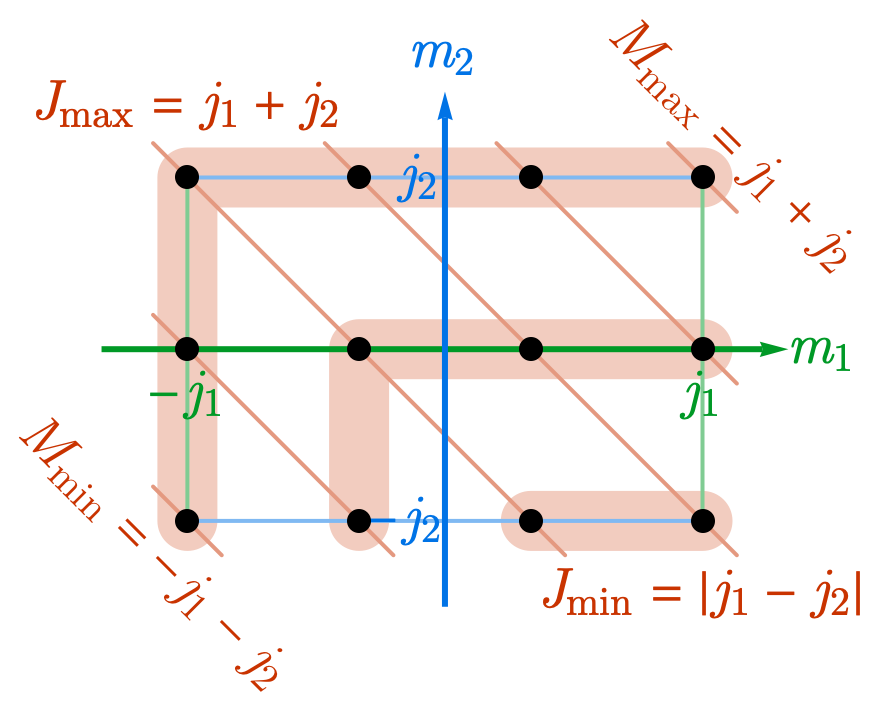
Fig. 4 Geometric counting on the \((m_1,m_2)\) grid: diagonal lines are fixed \(M=m_1+m_2\).#
Derivation: Triangle Rule
Strategy. Count how many uncoupled states share each value of \(M = m_1 + m_2\). Since each \(J\)-multiplet contributes exactly one state at every \(M\) from \(-J\) to \(+J\), the multiplicity \(n(M)\) tells us which \(J\) values appear.
Step 1 — Maximum \(J\). The largest possible \(M\) is \(M_{\max} = j_1 + j_2\), achieved uniquely by \((m_1, m_2) = (j_1, j_2)\). Since \(n(M_{\max}) = 1\), there is exactly one multiplet with \(J = j_1 + j_2\).
Step 2 — Peeling off multiplets. At \(M = j_1 + j_2 - 1\), there are two uncoupled states: \((j_1 - 1, j_2)\) and \((j_1, j_2 - 1)\). One of these belongs to the \(J = j_1 + j_2\) multiplet (reached by \(\hat{J}_-\)), so the remaining state must start a new multiplet with \(J = j_1 + j_2 - 1\).
More generally, the number of uncoupled states at a given \(M\) (with \(M \geq 0\), assuming \(j_1 \geq j_2\)) is
As \(M\) decreases from \(j_1 + j_2\), \(n(M)\) increases by one at each step — each new value of \(M\) reveals one new multiplet. This continues until \(M = j_1 - j_2\), after which \(n(M)\) saturates at \(2j_2 + 1\): no further multiplets appear.
Step 3 — Conclusion. Each integer step from \(J = j_1 + j_2\) down to \(J = j_1 - j_2\) contributes one multiplet, and the multiplicity count is exhausted. Therefore
Step 4 — Dimension check. Without loss of generality, assume \(j_1 \ge j_2\). Then \(J\) runs from \(j_1-j_2\) to \(j_1+j_2\), so
The coupled basis accounts for every state in \(\mathcal{H}_{j_1} \otimes \mathcal{H}_{j_2}\), confirming the decomposition is complete.
Clebsch-Gordan Coefficients#
Clebsch-Gordan Coefficients
The CG coefficients \(\langle j_1, m_1; j_2, m_2 \vert J, M\rangle\) express the coupled basis in terms of the uncoupled basis:
Properties:
Selection rule: nonzero only if \(M = m_1 + m_2\) and the triangle rule is satisfied
Reality: all CG coefficients are real (this is a gauge choice)
Orthonormality: \(\sum_{m_1,m_2} \langle j_1, m_1; j_2, m_2 \vert J, M\rangle\langle j_1, m_1; j_2, m_2 \vert J', M'\rangle = \delta_{JJ'}\delta_{MM'}\)
In practice, CG coefficients are looked up in tables or computed by algebra systems. For simple cases they can be derived by applying ladder operators starting from the stretched state \(\vert J_{\max}, J_{\max}\rangle = \vert j_1, j_1\rangle\vert j_2, j_2\rangle\).
Note: Iterative Computation of CG Coefficients
Methodology (iterative ladder method).
Start from the stretched state, whose coefficient is fixed:
Apply total lowering operator \(\hat J_- = \hat J_{1-}+\hat J_{2-}\) repeatedly to generate states with smaller \(M\) in the same multiplet.
Expand each coupled state in the uncoupled basis with \(m_1+m_2=M\), then fix unknown coefficients by normalization and orthogonality to already-known multiplets.
Repeat for lower \(J\) sectors after removing the higher-\(J\) subspace.
Why this works (brief proof idea). The coupled and uncoupled bases span the same fixed-\(M\) subspace. Since \(\hat J_-\) preserves \(J\) and lowers \(M\) by one, it gives recursion relations between neighboring \(M\) coefficients. Starting from the unique stretched state and imposing orthonormality determines all coefficients (up to an overall phase convention).
Example: \(\tfrac12\otimes\tfrac12\to 1\).
Start with
Apply \(\hat J_-\):
But also
Therefore
Hence the two nonzero CG coefficients for \(J=1, M=0\) are
Key Example: Two Spin-1/2 Particles#
For \(j_1 = j_2 = 1/2\): \(J \in \{0, 1\}\), giving \(1 + 3 = 4 = 2 \times 2\) states.
Triplet States (\(J = 1\), Symmetric)
All three are symmetric under particle exchange: \(\hat{P}_{12}\vert 1, M\rangle = +\vert 1, M\rangle\).
Singlet State (\(J = 0\), Antisymmetric)
The singlet is antisymmetric: \(\hat{P}_{12}\vert 0, 0\rangle = -\vert 0, 0\rangle\). It has zero total spin and is maximally entangled — measuring one particle’s spin along any axis completely determines the other’s.
Physical consequences:
Helium ground state: Two electrons in the \(1s\) orbital have a symmetric spatial wavefunction, so the spin part must be the antisymmetric singlet — the electrons are spin-paired.
Pauli exclusion: Identical fermions in the same spatial state must form a spin singlet.
Discussion: total-spin measurement on uncoupled states
The uncoupled state \(\vert\uparrow\downarrow\rangle\) is an equal superposition of singlet and triplet (\(M = 0\)). If you measure \(\hat{J}^2_{\text{tot}}\) on this state, you get \(J = 0\) or \(J = 1\) with equal probability. Before measuring, does the system “have” a definite total spin? What does this tell us about the relationship between individual and collective quantum numbers?
Application — Spin-Orbit Coupling#
Spin-Orbit Interaction
An electron in an atom experiences a coupling between orbital and spin angular momentum:
Using \(\hat{\boldsymbol{J}} = \hat{\boldsymbol{L}} + \hat{\boldsymbol{S}}\), we can write \(\hat{\boldsymbol{L}} \cdot \hat{\boldsymbol{S}} = \frac{1}{2}(\hat{J}^2 - \hat{L}^2 - \hat{S}^2)\), which is diagonal in the coupled basis \(\vert\ell, s; j, m_j\rangle\):
For an electron (\(s = 1/2\)) with orbital quantum number \(\ell \geq 1\), two values are allowed: \(j = \ell + 1/2\) and \(j = \ell - 1/2\). Their energy splitting is the fine structure — a small but measurable correction. Example: the hydrogen \(2p\) level splits into \(2p_{3/2}\) and \(2p_{1/2}\), a preview of perturbation theory in §5.1.
Poll: Adding two spin-1/2 systems
When you add two spin-1/2 particles (each with \(s = 1/2\)), what are the possible values of total spin \(s\)?
(A) Only \(s = 1\) (spins must align).
(B) Only \(s = 0\) (spins must anti-align).
(C) Both \(s = 0\) and \(s = 1\) (from \(|1/2 - 1/2|\) to \(1/2 + 1/2\)).
(D) All values in \(\{0, 1/2, 1, 3/2, \ldots\}\).
Summary#
Two bases: uncoupled (\(m_1, m_2\) known) vs. coupled (\(J, M\) known), related by CG coefficients.
Triangle rule: \(J \in \{\vert j_1 - j_2\vert, \ldots, j_1 + j_2\}\); dimension count: \(\sum(2J+1) = (2j_1+1)(2j_2+1)\).
Clebsch-Gordan coefficients: real, unitary, nonzero only when \(M = m_1 + m_2\) and triangle rule holds.
Two spin-1/2: triplet (\(J = 1\), symmetric, 3 states) + singlet (\(J = 0\), antisymmetric, maximally entangled).
Spin-orbit coupling: \(\hat{\boldsymbol{L}} \cdot \hat{\boldsymbol{S}}\) is diagonal in the coupled basis; causes atomic fine structure.
See Also
2.2.2 Spin Representations: Irreps and tensor-product Hilbert spaces whose coupled bases are built with Clebsch–Gordan coefficients here.
2.2.1 Angular Momentum Algebra: Ladder operators, \(J_\pm\), and the triangle rule that decide which total \(J\) appear in \(j_1\otimes j_2\).
2.1.2 Symmetrization: Identical particles in product spaces—singlet vs triplet constraints when two fermions share an orbital (as in the homework coupling problems).
Homework#
1. Angular momentum addition. For \(j_1 = 1\) and \(j_2 = 3/2\), list all allowed values of \(J\) using the triangle rule. Verify
2. Total angular momentum. For two spin-1/2 particles, derive the triplet and singlet states from scratch. Start from the stretched state \(\vert 1,1\rangle=\vert\uparrow\uparrow\rangle\), apply \(\hat J_-\) to obtain \(\vert 1,0\rangle\), then determine \(\vert 0,0\rangle\) by orthogonality and normalization.
3. Coupling scheme. Two identical fermions occupy the same spatial orbital \(\phi(\boldsymbol r)\). Explain why the spin state must be the singlet and why triplet spin states are forbidden.
★ 4. Spin-orbit coupling. A particle of orbital angular momentum \(\hat{\boldsymbol L}\) and spin \(\hat{\boldsymbol S}\) (with spin quantum number \(s = 1/2\)) has a spin-orbit interaction
where \(\lambda\) is a real coupling constant of dimension energy\(/\hbar^{2}\). Let \(\hat{\boldsymbol J} = \hat{\boldsymbol L} + \hat{\boldsymbol S}\) be the total angular momentum, and let \(\vert\ell, s; j, m_j\rangle\) denote the coupled basis — the simultaneous eigenstates of \(\{\hat L^{2}, \hat S^{2}, \hat J^{2}, \hat J_z\}\) with eigenvalues \(\hbar^{2}\ell(\ell+1)\), \(\hbar^{2}s(s+1)\), \(\hbar^{2}j(j+1)\), and \(\hbar m_j\), where the orbital quantum number \(\ell = 0, 1, 2, \ldots\), the total quantum number \(j \in \{\vert\ell - s\vert,\ldots,\ell + s\}\), and the magnetic quantum number \(m_j \in \{-j,\ldots,+j\}\).
(a) Show that
(b) Use (a) to compute \(\langle\hat{\boldsymbol L}\cdot\hat{\boldsymbol S}\rangle\) in the coupled state \(\vert\ell, \tfrac12; j, m_j\rangle\). Verify the answer is independent of \(m_j\).
(c) For the hydrogen \(2p\) level (\(\ell = 1\)), find the fine-structure splitting \(\Delta E\) between the \(j = 3/2\) and \(j = 1/2\) sublevels in terms of \(\lambda\).
★ 5. Spin-1 and spin-1/2 coupling. Consider spin-1 particle \(A\) and spin-1/2 particle \(B\), with total \(\hat{\boldsymbol J}=\hat{\boldsymbol S}_A+\hat{\boldsymbol S}_B\) and Hamiltonian
Work in the uncoupled basis \(\vert 1,m_A\rangle\vert\tfrac12,m_B\rangle\).
(a) Since \(\hat J_z\) commutes with \(\hat H\), block-diagonalize \(\hat H\) by fixed \(M=m_A+m_B\). Diagonalize each \(M\) block, then identify \(J\) from
so each eigenvalue determines whether the state belongs to \(J=\tfrac32\) or \(J=\tfrac12\). Check that for each fixed \(J\), the allowed \(M\) values run from \(-J\) to \(J\).
(b) Build the unitary matrix \(U\) from uncoupled to coupled basis,
with \(U_{(m_A,m_B),(J,M)}=\langle1,m_A;\tfrac12,m_B\vert J,M\rangle\). Explain why each fixed-\(M\) sub-block of \(U\) is exactly a Clebsch–Gordan coefficient matrix. Compute explicitly the \(M=\tfrac12\) block.
(c) Define projectors
Using the coupled states from parts (a)–(b), verify
Then show these projectors can be written as functions of \(\hat{\boldsymbol S}_A\cdot\hat{\boldsymbol S}_B\):
6. Lande g-factor. An atom has orbital angular momentum \(\ell\) and spin \(s\), coupling to total \(j = \vert\ell - s\vert, \ldots, \ell + s\). In a weak external magnetic field \(B\) along \(\boldsymbol{e}_z\), the magnetic energy is
with \(g_L = 1\), \(g_S = 2\) (electron values), and \(\mu_B = e\hbar/(2m_e)\) the Bohr magneton.
(a) In the coupled basis \(\vert\ell, s; j, m_j\rangle\), the operator \(\hat L_z + 2\hat S_z = \hat J_z + \hat S_z\) is not diagonal in \(j\) alone (it mixes different \(j\) values within the same \(m_j\)). Within a fixed-\(j\) subspace, any vector operator \(\hat{\boldsymbol V}\) has matrix elements proportional to those of \(\hat{\boldsymbol J}\):
This is the vector-projection identity: within a fixed-\(j\) subspace, the expectation of any vector operator equals the component along \(\hat{\boldsymbol J}\), scaled by \(m_j/j(j+1)\). (The perpendicular components average to zero by axial symmetry about \(\hat{\boldsymbol J}\) — cf. 2.2.1 P5 for the same averaging on \(\hat J_x\), \(\hat J_y\).)
(b) Using \(\hat{\boldsymbol J}\cdot\hat{\boldsymbol S} = \tfrac{1}{2}(\hat J^2 - \hat L^2 + \hat S^2)\) (derive this by squaring \(\hat{\boldsymbol L} = \hat{\boldsymbol J} - \hat{\boldsymbol S}\)), show
(c) Combine (a) and (b) to derive the Lande g-factor
so that the Zeeman energy shift in the coupled basis is \(\Delta E = g_J\mu_B B m_j\).
(d) Evaluate \(g_J\) for hydrogen \(2p_{3/2}\) (\(\ell = 1, s = 1/2, j = 3/2\)) and \(2p_{1/2}\) (\(\ell = 1, s = 1/2, j = 1/2\)). Show \(g_J(2p_{3/2}) = 4/3\) and \(g_J(2p_{1/2}) = 2/3\). The two fine-structure levels Zeeman-split by different amounts under the same field — the experimental signature that distinguishes spin from orbital angular momentum.
7. Two-electron exchange interaction. Two electrons interact through the exchange Hamiltonian \(\hat H_{\mathrm{ex}} = -J\,\hat{\boldsymbol S}_1\cdot\hat{\boldsymbol S}_2\) (with \(J\) the exchange coupling, \(\hat S = \hat\sigma/2\) in units of \(\hbar\)). This is the simplest two-spin Heisenberg model — the same operator appearing in 2.1.1 Problem 6 as the lattice Heisenberg interaction.
(a) Express \(\hat H_{\mathrm{ex}}\) in terms of the total spin operators using \(\hat S_{\mathrm{tot}}^2 = \hat S_1^2 + \hat S_2^2 + 2\hat{\boldsymbol S}_1\cdot\hat{\boldsymbol S}_2\).
(b) Evaluate \(\hat H_{\mathrm{ex}}\) on the singlet \(\vert 0,0\rangle\) and on each triplet state \(\vert 1, M\rangle\). Show that the triplet has energy \(-J/4\) and the singlet has energy \(+3J/4\).
(c) Hence the singlet-triplet splitting is
For \(J > 0\) (ferromagnetic coupling), the triplet is the ground state — aligned spins are favoured. For \(J < 0\) (antiferromagnetic coupling), the singlet is the ground state — anti-aligned spins. Compare with the lattice Heisenberg model spectrum from 2.1.1 P6.
(d) Connect to two-electron chemistry. The Hund’s rule for filled subshells favours maximal \(S\) (triplet > singlet). Argue that this reflects an effectively ferromagnetic exchange between two electrons in the same orbital, originating from the electron-electron Coulomb repulsion combined with the antisymmetry of the spatial wavefunction (recall 2.2.3 Problem 3).